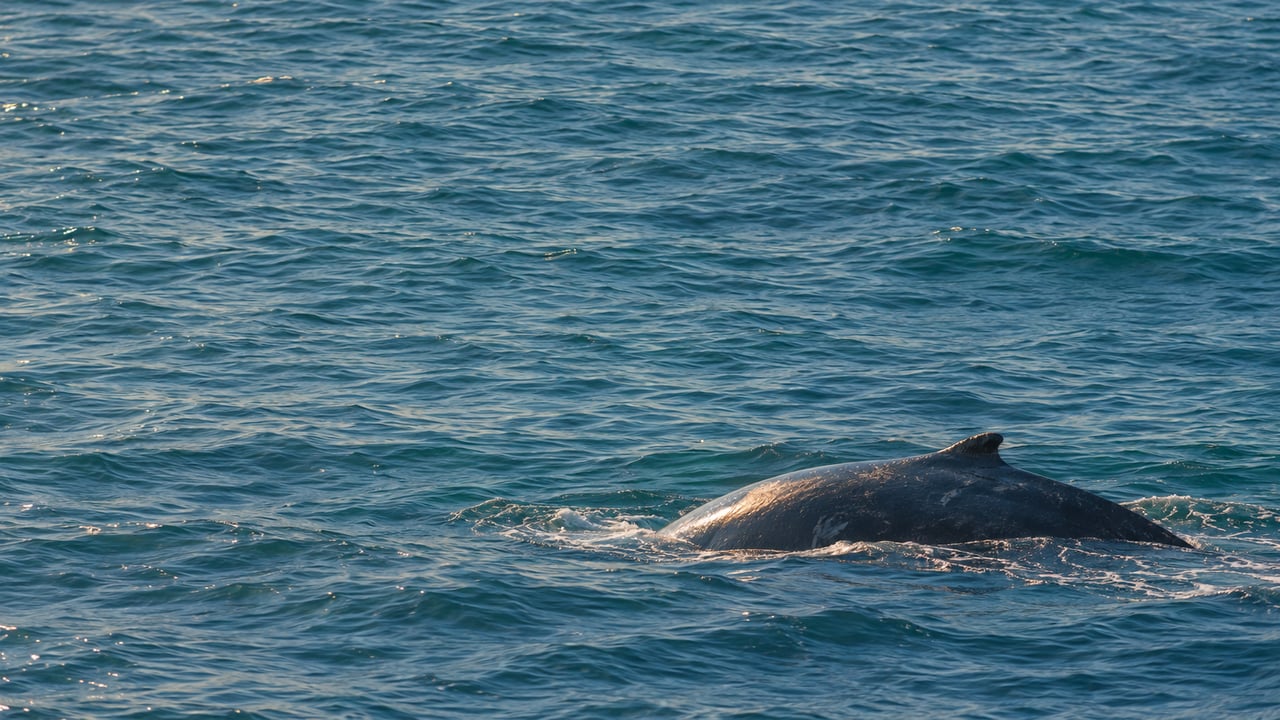
On November 3, Capt. Erica Page was running a Newport Coastal Adventure trip out of Newport Harbor when she found a pod of about 70 short-finned pilot whales. These are deep-water animals that usually stay in tropical seas. The Orange County Register reported it as the first local record of the species since the El Niño of 2014 and 2015. Two days later the same pod turned up about five miles off Dana Point Harbor.
Jessica Rodriguez is education manager for Davey's Locker and Newport Landing Whale Watching. In the Register's story she was careful about what caused the sighting: "With a strong El Niño currently underway, changing ocean conditions might be influencing the presence of these unusual visitors, although we cannot say for certain what brought them here."
Most years, Newport's whale season is a simple story. Gray whales pass through in winter and spring, usually December through April. This year the gray whales will arrive in an ocean that already looks different. If you live a few minutes from the Balboa Pavilion, the strange part of the season is happening right now, ahead of the gray whale months.
What the fleet's log shows this fall
Davey's Locker, Newport Landing and Newport Coastal Adventure post their sightings to one shared daily log. Read over the past six weeks, it shows what the ocean off the harbor entrance has been doing.
In the first two weeks of November, the log lists humpback whales on every day it covers, from November 1 through November 14. Daily counts ran from 3 to 25, and the high came on November 12. Common dolphins came in the hundreds or thousands most days, with 2,200 on November 12 alone. The log also recorded Risso's dolphins, Pacific white-sided dolphins and bottlenose dolphins. October was stranger. The log lists 20 orcas on October 24 and 7 more on October 25. It also has a hammerhead shark on October 23, seven marlin on October 17, mola mola on October 12 and 13, and an elephant seal and a sea turtle on October 16.
Gray whales appear only once in that stretch. The log recorded two of them on November 4, a few weeks before the usual December start.
The forecast behind that log is unusually strong. On November 12, 2026, NOAA's Climate Prediction Center kept its El Niño Advisory in place. It put the chance of a strong to very strong El Niño through January to March 2027 at greater than 79 percent. In the October to December and November to January windows, it gave about a 60 percent chance of an event larger than any El Niño on record back to 1950. The Niño-3.4 index has already reached +2.5°C. The agency expects El Niño to keep strengthening before it begins to weaken in early 2027. Its next discussion is scheduled for December 10.
The warmth started months ago
The pilot whales were the latest in a long run of warm-water visitors. On August 22, a hammerhead was recorded about a mile off Laguna Beach. The Register reported Southern California coastal water in the mid-70s that week and noted other recent hammerhead sightings. On August 25, the Register cited Scripps readings of 74°F in Santa Monica Bay and 77°F at Torrey Pines. Both were six degrees above normal, and the Santa Monica Bay reading set a daily record.
Anglers saw it too. The Register's September 3 fishing report said Dana Wharf had counted 1,689 yellowtail so far that season, against 234 the year before. Captains credited the warm water and the conditions pushing fish north. Yellowtail were still showing up in mid-November. Newport Landing Sportfishing's count for November 11 lists two among its Catalina Island catch, and its November 13 coastal trips brought in calico bass, sand bass and whitefish.
The summer's warm water began as a marine heat wave. In June 2026, NOAA Fisheries said the marine heat waves along the West Coast were not directly tied to El Niño at that point. It expected El Niño's influence to grow into the fall. In other words, the warm water came first, and El Niño has been building on top of it.
The newest milestone happened up the coast. On November 14, the Aquarium of the Pacific and wildlife officials released 54 olive ridley sea turtle hatchlings after the first documented nesting of the species off Southern California. The Register reported ocean temperatures still in the 70s. A wildlife official told the paper that warm water was part of the explanation for the nesting, but not all of it.
The gray whales coming south into this ocean
The gray whales passing Newport this winter come from a population that has been hard to count. NOAA estimated the eastern North Pacific population at 25,000 to 30,000 animals in 2016, near the top of a record that goes back to 1967. Strandings rose from late 2018, and NOAA declared an unusual mortality event that lasted through November 2023. By the winter of 2022 to 2023, the estimate had fallen to about 13,300 to 16,000 whales.
The two most recent counts moved a lot. NOAA put the 2024 to 2025 population at about 11,700 to 14,200 whales. The 2025 to 2026 estimate rose to 15,930 to 20,530, according to NOAA's population page. The agency's July 2026 technical memorandum gives a point estimate of 17,750 whales for that season. NOAA says the jump is faster than births and deaths alone could explain. It names two possible causes: gray whales changing their migration routes, or factors in the survey itself.
Calf numbers have not recovered. NOAA's 2025 calf-production estimate was about 84.6 mother-calf pairs, the lowest since the series began in 1994. The agency writes that low calf production since 2019 raises concerns about how well the population can recover, even with the higher overall estimate.
The closest shore count to Newport comes from the American Cetacean Society's Los Angeles chapter, which counts gray whales from Point Vicente on the Palos Verdes Peninsula. Its 2024 to 2025 summary covers December 1, 2024 through May 25, 2025. Counters logged 130 southbound gray whales with no calves and 485 northbound whales with eight calves. The season before, from December 2023 to May 2024, they logged 225 southbound with 22 calves and 579 northbound with 34 calves. The chapter notes that these nearshore counts are not population estimates, because many gray whales migrate farther offshore. That difference between the coastline and open water matters most for anyone watching from Newport.
El Niño could change the picture. A 2015 study in PLOS ONE used breeding-lagoon counts from 1997 to 2002. During the 1998 El Niño, it found fewer mother-calf pairs in the southernmost study area and more along the California coast. The authors said this fit a northward shift in warm years, but the shift showed up only at the southern edge of the whales' winter range. That shows warm water can affect where gray whales spend the winter. It does not predict how many will pass Newport this season.
Getting on the water from the Peninsula
All three operators in the shared log leave from the Balboa Peninsula. Davey's Locker departs from the historic Balboa Pavilion. Its seasonal guide lists gray whales as the winter and spring species, and blue and fin whales as more typical in summer and fall. This fall the log recorded fin whales on September 25, 29 and 30. Newport Landing checks guests in at either 309 Palm Street or 400 Main Street, and the boat you are on decides which. Check your confirmation before you walk over from Balboa Village.
You can choose from three kinds of trips. The standard large-boat cruise runs two to two and a half hours. A smaller luxury catamaran is another option. The fastest is the two-hour "Ultimate" trip on Newport Coastal Adventure's Zodiac boats, the same company whose captain found the pilot whales. The Register reported that the pilot whale pod was close enough for both the larger vessels and the smaller boats to reach. Visit Newport Beach notes that the fleet runs tours year-round, so you don't need to wait for December to book.
From shore, Orange County Outdoors names Lookout Point in Corona del Mar, at 3001 Ocean Boulevard, above the Newport Harbor entrance. It describes the point as a place where patient watchers may see whales and dolphins. Our Corona del Mar neighborhood page covers more of the bluff side of the harbor mouth.
Down the coast, Dana Point Harbor has its 56th Festival of Whales on the calendar for March 5 through 7, 2027. That falls inside the usual gray whale season, and inside the window when NOAA expects El Niño to begin weakening. For readers who already know the harbor from the bay side, our earlier piece on the Back Bay's fall bird migration follows a different migration on the same calendar.
Many of the homes closest to this season are the ones on the Balboa Peninsula and at Peninsula Point, where the whale boats pass the harbor entrance on their way out. If you own one of them and want to know what that address is worth this winter, Kim Bibb can give you a discreet answer. Request a Confidential Home Valuation.